
The socialist State
actually existing socialism

Hegel observed, “We learn from history that we do not learn from history.”
Most of us don’t even read about the history we humans have made. You can’t learn about something that you’re mostly unaware of. For instance, you can’t learn about how to repair a car, if you know nothing about how it operates. You can’t learn how to properly remove a cyst, if you know nothing about what it is under the skin. You can make up a mythology about historical events or car repair or medical procedures. But will those ideas actually work to solve the issues?
The human mind is geared toward solving problems and has actually solved quite a few over the tens of thousands of years homos, including Homo Erectus, Homo neanderthalensis and Homo sapiens have been around. But that learning took a lot of time, trial and error. And, the final results weren’t directly linked with the power of the mind to make assertions about realities around us, although, without the creative power of the mind, no working result would have occurred either.
Getting back to historical endeavors, some of us have read about what occurred in the past. However, those written histories have the limitation of having been written by individuals who themselves are or were socialised within a set of dominant ideas and practices within the actually existing material conditions of the time in which they live or lived. Thus, we peer back in time through the filtering mind lens of an individual whose thinking was influenced by the norms extant during his or her life. One should read the written histories of these writers, with the caveat that they do not tell the whole story and the truths unfolded within them may have been distorted by the writers’ own believed-in myths, morals and ethics. Faith is also the creation of the human mind. False premises lead to erroneous conclusions.
And so, we come, assertions and faith aside, to the 19th century A.D., 1900 years after the birth of a male who may or may not have actually existed as one person in what is now called, ‘The Middle East’. As everyone is supposed to know, the 19th century was the 18 hundreds. Between January and March of 1880, Engels wrote a pamphlet titled, Socialism Utopian and Scientific , which was his attempt to deal with the question of well intentioned efforts to construct a modern socialist system of production and wealth distribution within the more generalised social relation of Capital. It may help, if one reads what he wrote.
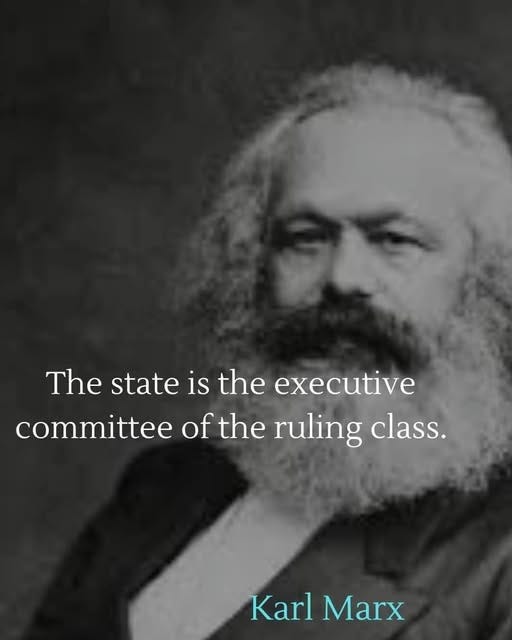
You can search high and low in the writings of Marx and Engels and not find one word endorsing the concept of a ‘socialist State’. However, you will find plenty of critiques of that concept. Marx writing in 1844:
From a political point of view, the state and the organization of society are not two different things. The state is the organization of society. In so far as the state acknowledges the existence of social grievances, it locates their origins either in the laws of nature over which no human agency has control, or in private life, which is independent of the state, or else in malfunctions of the administration which is dependent on it. Thus England finds poverty to be based on the law of nature according to which the population must always outgrow the available means of subsistence. From another point of view, it explains pauperism as the consequence of the bad will of the poor, just as the King of Prussia explains it in terms of the unchristian feelings of the rich and the Convention explains it in terms of the counter-revolutionary and suspect attitudes of the proprietors. Hence England punishes the poor, the Kings of Prussia exhorts the rich and the Convention he heads, the proprietors.
Lastly, all states seek the cause in fortuitous or intentional defects in the administration and hence the cure is sought in administrative measures. Why? Because the administration is the organizing agency of the state.
The contradiction between the vocation and the good intentions of the administration on the one hand and the means and powers at its disposal on the other cannot be eliminated by the state, except by abolishing itself; for the state is based on this contradiction. It is based on the contradiction between public and private life, between universal and particular interests. For this reason, the state must confine itself to formal, negative activities, since the scope of its own power comes to an end at the very point where civil life and work begin. Indeed, when we consider the consequences arising from the asocial nature of civil life, of private property, of trade, of industry, of the mutual plundering that goes on between the various groups in civil life, it becomes clear that the law of nature governing the administration is impotence. For, the fragmentation, the depravity, and the slavery of civil society is the natural foundation of the modern state, just as the civil society of slavery was the natural foundation of the state in antiquity. The existence of the state is inseparable from the existence of slavery. The state and slavery in antiquity – frank and open classical antitheses – were not more closely welded together than the modern state and the cut-throat world of modern business – sanctimonious Christian antithesis. If the modern state desired to abolish the impotence of its administration, it would have to abolish contemporary private life. And to abolish private life, it would have to abolish itself, since it exists only as the antithesis of private life. However, no living person believes the defects of his existence to be based on the principle, the essential nature of his own life; they must instead be grounded in circumstances outside his own life. Suicide is contrary to nature. Hence, the state cannot believe in the intrinsic impotence of its administration – i.e., of itself. It can only perceive formal, contingent defects in it and try to remedy them. If these modification are inadequate, well, that just shows that social ills are natural imperfections, independent of man, they are a law of God, or else, the will of private individuals is too degenerate to meet the good intentions of the administration halfway. And how perverse individuals are! They grumble about the government when it places limits on freedom and yet demand that the government should prevent the inevitable consequences of that freedom!
The more powerful a state and hence the more political a nation, the less inclined it is to explain the general principle governing social ills and to seek out their causes by looking at the principle of the state – i.e., at the actual organization of society of which the state is the active, self-conscious and official expression. Political understanding is just political understanding because its thought does not transcend the limits of politics. The sharper and livelier it is, the more incapable is it of comprehending social problems. The classical period of political understanding is the French Revolution. Far from identifying the principle of the state as the source of social ills, the heroes of the French Revolution held social ills to be the source of political problems. Thus Robespierre regarded great wealth and great poverty as an obstacle to pure democracy. He therefore wished to establish a universal system of Spartan frugality. The principle of politics is the will. The more one-sided – i.e., the more prefect – political understanding is, the more completely it puts its faith in the omnipotence of the will the blinder it is towards the natural and spiritual limitations of the will, the more incapable it becomes of discovering the real source of the evils of society. No further arguments are needed to prove that when the “Prussian” claims that “the political understanding” is destined “to uncover the roots of social want in Germany” he is indulging in vain illusions.
And here’s Engels:
The free people’s state is transformed into the free state. Grammatically speaking, a free state is one in which the state is free vis-à-vis its citizens, a state, that is, with a despotic government. All the palaver about the state ought to be dropped, especially after the Commune, which had ceased to be a state in the true sense of the term. The people’s state has been flung in our teeth ad nauseam by the anarchists, although Marx’s anti-Proudhon piece and after it the Communist Manifesto declare outright that, with the introduction of the socialist order of society, the state will dissolve of itself and disappear. Now, since the state is merely a transitional institution of which use is made in the struggle, in the revolution, to keep down one’s enemies by force, it is utter nonsense to speak of a free people’s state; so long as the proletariat still makes use of the state, it makes use of it, not for the purpose of freedom, but of keeping down its enemies and, as soon as there can be any question of freedom, the state as such ceases to exist. We would therefore suggest that Gemeinwesen [”commonalty”] be universally substituted for state; it is a good old German word that can very well do service for the French “Commune.”
I shall present an aside here which may keep one on tract because, low and behold, The Bolshevik Revolution. The fact of the matter is that more than 80% of the people in the former Tsarist Empire who became citizens of the USSR in 1922 were illiterate peasants who had faith that the Jews were responsible for the murder of the Son of God and that the Bolshevik leadership were representatives of the AntiChrist. Read Victor Serge’s account of him and some of his comrades attempting to set up a communal farm in the very early 20s. See pages 110-135:
The situation that the Bolsheviks found themselves in, in 1924 was that their political revolution had not sparked a successful social revolution in the industrialised States of the world. The question put before them was what to do with State power from then on. Different factional leaders had different answers and they fought it out, even though at the 1921 10th Party Congress, Lenin’s resolution outlawing factions had passed. Lenin went on to suggest Stalin as the best candidate for the position of General Secretary. After Lenin died, Stalin thought that the Bolsheviks should use their political power to preserve the Soviet political State and to attempt to lead the peasants and workers to industrialisation and the Ideal of a classless society through a bureaucratically imposed wage system, producing commodified wealth to be exchanged for the universal equivalent commodity, money. The idea was to gradually equalise wages, but the reality was that the top bureaucrats and other professionals needed to reproduce the division of labour were paid way more than than the lower strata of workers and peasants. Here’s Marx on what should have been done:
“On the basis of socialised production the scale must be ascertained on which those operations — which withdraw labour-power and means of production for a long time without supplying any product as a useful effect in the interim — can be carried on without injuring branches of production which not only withdraw labour-power and means of production continually, or several times a year, but also supply means of subsistence and of production. Under socialised as well as capitalist production, the labourers in branches of business with shorter working periods will as before withdraw products only for a short time without giving any products in return; while branches of business with long working periods continually withdraw products for a longer time before they return anything. This circumstance, then, arises from the material character of the particular labour-process, not from its social form. In the case of socialised production the money-capital is eliminated. Society distributes labour-power and means of production to the different branches of production. The producers may, for all it matters, receive paper vouchers entitling them to withdraw from the social supplies of consumer goods a quantity corresponding to their labour-time. These vouchers are not money. They do not circulate.”CAPITAL Volume II, chapter 18, page 358
But enough of the Marxist-Leninist attempt. What about the ‘socialist State’? Here Marx critiques the idea as proposed by the German Social Democratic Party at Gotha in 1875:
I come now to the democratic section.A. “The free basis of the state.”
First of all, according to II, the German Workers’ party strives for “the free state”.
Free state — what is this?
It is by no means the aim of the workers, who have got rid of the narrow mentality of humble subjects, to set the state free. In the German Empire, the “state” is almost as “free” as in Russia. Freedom consists in converting the state from an organ superimposed upon society into one completely subordinate to it; and today, too, the forms of state are more free or less free to the extent that they restrict the “freedom of the state”.
The German Workers’ party — at least if it adopts the program — shows that its socialist ideas are not even skin-deep; in that, instead of treating existing society (and this holds good for any future one) as the basis of the existing state (or of the future state in the case of future society), it treats the state rather as an independent entity that possesses its own intellectual, ethical, and libertarian bases.
And what of the riotous misuse which the program makes of the words “present-day state”, “present-day society”, and of the still more riotous misconception it creates in regard to the state to which it addresses its demands?
“Present-day society” is capitalist society, which exists in all civilized countries, more or less free from medieval admixture, more or less modified by the particular historical development of each country, more or less developed. On the other hand, the “present-day state” changes with a country’s frontier. It is different in the Prusso-German Empire from what it is in Switzerland, and different in England from what it is in the United States. The “present-day state” is therefore a fiction.
Nevertheless, the different states of the different civilized countries, in spite or their motley diversity of form, all have this in common: that they are based on modern bourgeois society, only one more or less capitalistically developed. They have, therefore, also certain essential characteristics in common. In this sense, it is possible to speak of the “present-day state” in contrast with the future, in which its present root, bourgeois society, will have died off.
The question then arises: What transformation will the state undergo in communist society? In other words, what social functions will remain in existence there that are analogous to present state functions? This question can only be answered scientifically, and one does not get a flea-hop nearer to the problem by a thousand-fold combination of the word ‘people’ with the word ‘state’.
Between capitalist and communist society there lies the period of the revolutionary transformation of the one into the other. Corresponding to this is also a political transition period in which the state can be nothing but the revolutionary dictatorship of the proletariat.
Now the program does not deal with this nor with the future state of communist society.
Its political demands contain nothing beyond the old democratic litany familiar to all: universal suffrage, direct legislation, popular rights, a people’s militia, etc. They are a mere echo of the bourgeois People’s party, of the League of Peace and Freedom. They are all demands which, insofar as they are not exaggerated in fantastic presentation, have already been realized. Only the state to which they belong does not lie within the borders of the German Empire, but in Switzerland, the United States, etc. This sort of “state of the future” is a present-day state, although existing outside the “framework” of the German Empire.
But one thing has been forgotten. Since the German Workers’ party expressly declares that it acts within “the present-day national state”, hence within its own state, the Prusso-German Empire — its demands would indeed be otherwise largely meaningless, since one only demands what one has not got — it should not have forgotten the chief thing, namely, that all those pretty little gewgaws rest on the recognition of the so-called sovereignty of the people and hence are appropriate only in a democratic republic.
Now, here is Engels writing to Bebel around the same time Marx was making his critique of the Gotha Programme in 1875:
The people’s state has been flung in our teeth ad nauseam by the anarchists, although Marx’s anti-Proudhon piece and after it the Communist Manifesto declare outright that, with the introduction of the socialist order of society, the state will dissolve of itself and disappear. Now, since the state is merely a transitional institution of which use is made in the struggle, in the revolution, to keep down one’s enemies by force, it is utter nonsense to speak of a free people’s state; so long as the proletariat still makes use of the state, it makes use of it, not for the purpose of freedom, but of keeping down its enemies and, as soon as there can be any question of freedom, the state as such ceases to exist. We would therefore suggest that Gemeinwesen [”commonalty”] be universally substituted for state; it is a good old German word that can very well do service for the French “Commune.”
Again, Marx and Engels did propose that the workers organise as a class to win the battle for democracy. They did endorse the concept of establishing a proletarian democracy to replace bourgeois democracy. As a proletarian democracy would be under the control of the immense majority, it would still imply that other classes exist. Thus, such a democratic republic would be a dictatorship of the dominant class, just as a bourgeois democracy was seen by them as being the dictatorship of a class, the upper 10%, the bourgeoisie. The point of a proletarian democracy would be to see to it that classes were abolished and the political State replaced by an administration of the goods and services resulting from the labour process, that is, to common ownership of the wealth crystalised in the collective product of labour and natural resources.
This is way Engels put it:
Engels on what socialism would first look like:With the seizing of the means of production by society production of commodities is done away with, and, simultaneously, the mastery of the product over the producer. Anarchy in social production is replaced by systematic, definite organisation. The struggle for individual existence disappears. Then for the first time man, in a certain sense, is finally marked off from the rest of the animal kingdom, and emerges from mere animal conditions of existence into really human ones. The whole sphere of the conditions of life which environ man, and which have hitherto ruled man, now comes under the dominion and control of man who for the first time becomes the real, conscious lord of nature because he has now become master of his own social organisation. The laws of his own social action, hitherto standing face to face with man as laws of nature foreign to, and dominating him, will then be used with full understanding, and so mastered by him. Man’s own social organisation, hitherto confronting him as a necessity imposed by nature and history, now becomes the result of his own free action. The extraneous objective forces that have hitherto governed history pass under the control of man himself. Only from that time will man himself, with full consciousness, make his own history — only from that time will the social causes set in movement by him have, in the main and in a constantly growing measure, the results intended by him. It is the humanity’s leap from the kingdom of necessity to the kingdom of freedom.
Anti-Dühring, 1877
This is the way Marx and Engels put it in 1848:
When, in the course of development, class distinctions have disappeared, and all production has been concentrated in the hands of a vast association of the whole nation, the public power will lose its political character. Political power, properly so called, is merely the organised power of one class for oppressing another. If the proletariat during its contest with the bourgeoisie is compelled, by the force of circumstances, to organise itself as a class, if, by means of a revolution, it makes itself the ruling class, and, as such, sweeps away by force the old conditions of production, then it will, along with these conditions, have swept away the conditions for the existence of class antagonisms and of classes generally, and will thereby have abolished its own supremacy as a class.In place of the old bourgeois society, with its classes and class antagonisms, we shall have an association, in which the free development of each is the condition for the free development of all.
This is the way Daniel DeLeon put the matter in 1905:
The evolution from the capitalist system to Socialism marks a revolution of first rank. The methods of the Socialist Republic will be methods that flow from its own material framework. The latter is so diametrically the opposite of the capitalist social framework that the two methods will bear no comparison. Capitalist society requires the political State; accordingly, its economics translate themselves into political tenets; Socialist society, on the contrary, knows nothing of the political State: in Socialist society the political State is a thing of the past, either withered out of existence by disuse or amputated” according as circumstances may dictate.
Daniel DeLeon, 1905